
Rubio’s blunt warning to Tehran—threaten a U.S. destroyer and “you’re going to get blown up”—signals Washington will not yield an inch in the Strait of Hormuz showdown.
Story Snapshot
- Rubio says Iranian forces fired on U.S. destroyers in international waters; U.S. returned fire defensively [2].
- Rubio warns Iran is trying to “normalize” control over the Strait of Hormuz, calling it illegal and unacceptable [3][5].
- Administration frames recent U.S. strikes as defensive and distinct from broader operations [5].
- Iran-linked outlets claim U.S. hit Iranian tankers first, casting Tehran’s actions as retaliation [7][9].
Rubio’s Account Of The Clash And A Clear Deterrent Message
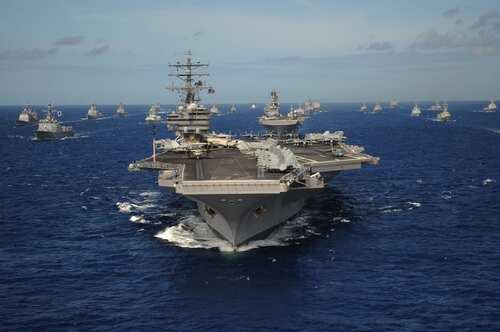
Secretary of State Marco Rubio stated that Iranian forces fired on U.S. Navy destroyers transiting international waters near the Strait of Hormuz and that American ships returned fire to protect themselves. He emphasized that any approach or attack by Iranian fast boats, drones, or missiles at U.S. vessels will be met with force, saying, “We’re going to blow those boats up if they’re coming towards our boats.” Rubio’s deterrent message underscores the administration’s red line: do not threaten American sailors [2].
Rubio further asserted that Iran has been attempting to “normalize” de facto control over an international waterway by shaping traffic and behavior in the Strait of Hormuz. He labeled such efforts “illegal” and “unacceptable,” warning that conceding to these maneuvers would set a dangerous precedent other hostile regimes could copy. His comments align with a long-standing U.S. position that critical sea lanes must remain open for lawful navigation without harassment or unauthorized control [3][5].
Defensive Strikes And The Separation From Broader Campaigns
Rubio characterized recent U.S. military strikes as defensive actions taken to neutralize immediate threats, and he distinguished them from a broader campaign often discussed in the region. By drawing a line between defensive responses to attacks on U.S. ships and separate operational planning, Rubio aimed to show proportionality and restraint. This framing seeks to reassure allies and markets that the United States is acting to protect its forces, not to launch a wider war in the Gulf [5].
According to Rubio’s remarks, Iranian forces reportedly targeted three American destroyers using fast-attack craft, missiles, or drones, prompting U.S. defensive fire. The administration’s narrative emphasizes necessity and self-defense as guiding principles for any engagement. While that account is forceful and specific, it currently relies on official statements rather than publicly released incident logs, video, or third-party verification that could lock down the precise sequence of events at sea [2].
Competing Claims, Missing Public Evidence, And What To Watch
Counter-claims in regional media assert the United States struck two Iranian-flagged tankers in violation of a ceasefire and that Iranian actions were retaliatory. These accounts paint Washington as the escalator and frame Tehran’s response as compelled by “American terrorism.” However, such reports do not address Rubio’s core assertion that Iranian units fired first on U.S. destroyers in international waters, and they have not produced radar logs, launch records, or neutral verification to rebut that timeline [7][9].
“Only stupid countries don’t shoot back when you’re shot at”
Marco Rubio, US Secretary of State, defends the US retaliation following an attack on a Navy ship, saying Iran started the confrontation and the response was warranted pic.twitter.com/CK0hAVqJKE
— TRT World (@trtworld) May 8, 2026
Key gaps remain. Publicly available U.S. Navy after-action reports, radar tracks, or shipboard video confirming first fire have not yet been released. Similarly, Iran has not provided documentary evidence that disproves the U.S. account or substantiates its tanker-centered narrative in a way that explains the destroyer engagements. For Americans who value peace through strength and open sea lanes, the next indicators to watch are official incident reports, any international maritime findings, and whether commercial traffic faces renewed intimidation [2][5][7].
Sources:
[2]
[3] Rubio Presses Europe on Iran Action as He Seeks to Mend Ties …
[5] Rubio: Friday’s U.S. Strikes in Iran Were Defensive – IranWire
[7] US fire on Iran tankers sparks reprisals as deal hangs in balance
[9]