
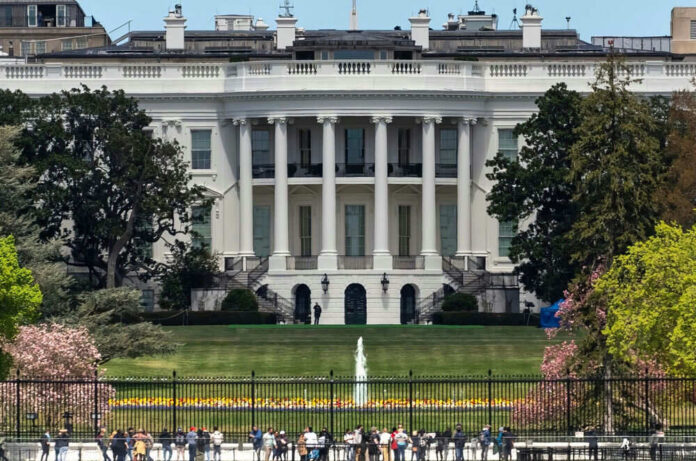
An armed suspect opened fire just steps from the White House perimeter, forcing a lockdown and reminding Americans that political violence is still knocking at our front door.
Story Snapshot
- Secret Service officers shot an armed suspect near the White House after an exchange of gunfire.
- A teenage bystander was wounded, raising fears about public safety around America’s most protected address.
- The White House North Lawn was briefly evacuated as part of emergency lockdown procedures.
- Key details about the suspect’s motive and path remain unclear, fueling debate over security and political violence.
Gunfire Near The People’s House Exposes Ongoing Security Risks
Secret Service officers engaged in a gun battle Monday afternoon near the National Mall, close to the White House, after spotting a man who appeared to be armed and who then opened fire while fleeing from officers. Officials say the confrontation occurred near the Washington Monument area, outside the formal White House complex but within the broader security envelope that surrounds it, underscoring that determined attackers can still reach the perimeter zone before being stopped.[1][2]
According to Deputy Director Matthew Quinn of the United States Secret Service, a plainclothes officer first noticed a “suspicious individual that appeared to have a firearm” around 3:30 p.m. near the National Mall. Uniformed Secret Service police then moved in, at which point the suspect ran and opened fire toward the officers, triggering an exchange of gunfire that ended only after agents shot and wounded the suspect, who was later identified by authorities as Michael Marx.[1][2]
Teen Bystander Wounded As White House Locks Down
During the shootout, a male juvenile bystander was struck and injured, apparently by gunfire from the suspect, and transported to a hospital with what officials described as non-life-threatening wounds; he has since been released. The suspect was hit multiple times and remains hospitalized. The incident was serious enough that the White House North Lawn was evacuated and the building briefly locked down, as agents moved swiftly to secure the grounds and move personnel out of exposed outdoor areas.[1][2][4]
Federal and local authorities stressed that the suspect never breached the formal White House perimeter fence, and that the threat was contained outside the complex itself, although the area affected was within the highly trafficked, supposedly secure zone where tourists and workers pass daily.[2][4] A senior official emphasized that the layers of security did their job by detecting, pursuing, and stopping the attacker before he could move closer, but the very need to clear the North Lawn showed how quickly a nearby threat can disrupt operations.[2][4]
Unclear Motive, Troubling Pattern Of Political Violence Concerns
Prosecutors say they intend to charge Marx with assault on a federal officer, a serious offense that reflects the reality that he fired directly at agents tasked with protecting the president and the seat of government.[2] United States Attorney Jeanine Pirro reportedly stated that Marx “starts shooting at the Secret Service” and “gets shot a few times,” describing a rapid, close-quarters gunfight in a public space. Officials have also said they are still working to determine why Marx was in Washington and what precisely he intended to do near the complex.[1][2]
UPDATE ON SHOOTING OUTSIDE OF WHITE HOUSE:
-Around 6pm, a gunman approached White House gate on the West Side
-Gunman brandished a pistol, fired 3x toward White House
-Secret Service returned fire
-Gunman taken down
-The gunman never got past the perimeter…— The National Desk (@TND) May 24, 2026
Reporting indicates that Marx allegedly shouted profanities about the White House, which, combined with the location and timing of the attack, has deepened worries about politically tinged violence in the capital.[2] This episode follows a broader historical pattern: in 2011, an attacker parked on Constitution Avenue and fired multiple rounds from a semi-automatic rifle at the White House, with at least seven bullets hitting the second floor and causing tens of thousands of dollars in damage, even though no one was hurt.[3] That history reinforces concerns that, despite upgrades, this symbol of our republic remains a high-value target.
Security Layers Worked, But Everyday Americans Still Paid A Price
Supporters of the current White House security design argue that the incident proves the layered perimeter works, because the suspect was detected outside the fence, engaged by multiple officers, and prevented from breaching the grounds.[2][4] On this view, the system did what it was built to do: identify a threat, move quickly to stop it, and lock down the complex while agents resolved the danger, all without harm to the president, staff, or the building itself. The overlapping presence of Secret Service, local police, and federal support agencies illustrates a deliberately thick security environment.[4]
At the same time, conservatives who value both strong security and limited government rightly point out that an innocent teenager still ended up in the hospital because an armed man got close enough to unleash gunfire in what should be one of the safest public areas in the country.[2] The fact that motives remain murky limits how confidently anyone can label this a one-off incident or a symptom of deeper breakdowns in social order, mental health, or political rhetoric, but for many Americans, the optics alone reinforce a sense that the culture is fraying and that violence is edging closer to our national institutions.[1][2]
Debate Ahead: Hardening The Perimeter Without Locking Out The People
This shooting will likely fuel a fresh debate about whether the White House perimeter should be pushed even farther out, as has happened in earlier years when new fencing, barricades, and expanded security zones were added in response to threats and protests.[5] Security professionals and many conservatives agree that the president’s safety is non-negotiable, yet there is also a legitimate concern that turning central Washington into a permanent fortress risks separating the “People’s House” from the people, and normalizing a state of emergency that never really ends.
For readers who care about constitutional government, the key questions now are straightforward: how did Marx reach that location with a gun, how quickly was he first identified as a threat, and what specific changes, if any, will meaningfully reduce risk without further shrinking public access and transparency?[2] Until the Secret Service and other agencies release detailed after-action reports, speculation will be cheap and loud on all sides. What is clear is that front-line agents responded with courage under fire, an innocent young American was caught in the crossfire, and the most visible symbol of our republic once again had to slam its doors shut, if only for a moment.
Sources:
[1] Web – Secret Service shoots armed man near White House – POLITICO
[2] Web – US attorney reveals new details about suspect in Secret Service …
[3] Web – 2011 White House shooting – Wikipedia
[4] YouTube – White House placed in lockdown after reported gunfire near complex
[5] Web – Secret Service to expand White House security perimeter on south …