

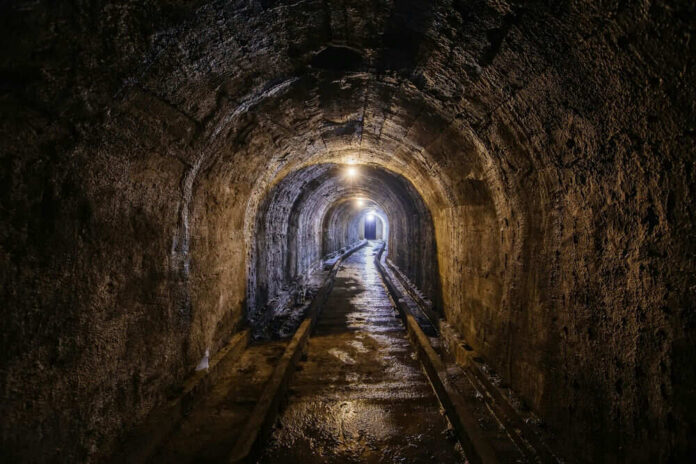
A hidden cartel tunnel tied into El Paso’s storm drains, proving once again that the border crisis is literally running beneath our feet.
Story Snapshot
- A sophisticated tunnel from Ciudad Juarez into El Paso’s storm drain was discovered in January 2025.
- The tunnel had lighting, ventilation, and a hidden exit into a city storm drain manhole.
- Officials confirm storm drains are being exploited, but Washington still has not mapped or cleaned up the full threat.
<li Cartels linked to the tunnel guided illegal migrants through the drains and into a box truck with a trap door.
Cartel Tunnel Hidden Inside El Paso’s Storm Drain System
On January 8–9, 2025, federal agents in El Paso uncovered a man-made tunnel running under the Rio Grande from Ciudad Juarez straight into the city’s storm drain system. The passage was about six feet tall and four feet wide, large enough for adults to walk upright. It was supported by wood beams and equipped with electricity and a ventilation system, showing careful planning and serious money. Agents found the U.S. exit concealed behind a metal cover inside the Boone Street storm drain, hidden in plain sight beneath a neighborhood street.
Homeland Security Investigations in El Paso said the tunnel appeared to have been built within the year before it was found. That suggests active, recent use, not some old, abandoned project. Border Patrol and Homeland Security Investigations teams discovered the connection while checking storm drains on both sides of the border. U.S. Border Patrol later began sealing the tunnel from the American side, while Mexican authorities moved to close their end and launched a wider search for other tunnels in the area.
How Smugglers Used Storm Drains, Trap Doors, and Box Trucks
Federal court records show how smugglers turned this tunnel and the storm drains into a pipeline. Prosecutors say Oscar Ivan Carrillo and others used handheld tools to punch new openings from existing storm drain tunnels into the main cross-border tunnel. These new cuts let them guide illegal migrants through the storm drains and into the United States with less risk of being spotted at the surface. At the end of the route, they parked a box truck over a manhole, then opened a trap door so migrants could climb straight into the truck from underground.
The Department of Justice also convicted Mexican national Ricardo Guadalupe Dominguez, known as “Mago,” for his role in the tunnel smuggling conspiracy. Court filings say he helped provide vehicles and tools to tamper with storm drains and support alien smuggling through subterranean passages. Together, these cases confirm that criminal networks were not just digging one tunnel, but were actively tying it into storm drains to move people secretly under a major U.S. city. That is exactly the type of hidden infrastructure many Americans fear when they hear about “porous borders.”
Storm Drains as a Smuggling Route — What We Know and What We Don’t
U.S. Customs and Border Protection has publicly warned that transnational criminal organizations in the El Paso sector exploit storm drain manholes inside the city to smuggle migrants illegally into the country. Border Patrol reported at least 69 migrants caught inside the El Paso storm drain system, in two separate groups, after using those drains to try to evade capture. These official statements back up the idea that storm drains are more than simple infrastructure; they have become a tool for illegal immigration and cartel activity.
𝐂𝐀𝐑𝐓𝐄𝐋𝐒 𝐀𝐑𝐄 𝐒𝐌𝐔𝐆𝐆𝐋𝐈𝐍𝐆 𝐌𝐈𝐆𝐑𝐀𝐍𝐓𝐒 𝐓𝐇𝐑𝐎𝐔𝐆𝐇 𝐌𝐈𝐋𝐄𝐒 𝐎𝐅 𝐒𝐓𝐎𝐑𝐌 𝐃𝐑𝐀𝐈𝐍𝐒 𝐔𝐍𝐃𝐄𝐑 𝐄𝐋 𝐏𝐀𝐒𝐎, 𝐂𝐇𝐀𝐑𝐆𝐈𝐍𝐆 𝐔𝐏 𝐓𝐎 $𝟑𝟎,𝟎𝟎𝟎 𝐀 𝐇𝐄𝐀𝐃
Fox News got rare access underground with Border Patrol’s elite confined space entry… pic.twitter.com/FEYH0hAOLW
— M.A. Rothman (@MichaelARothman) July 17, 2026
At the same time, primary documents so far confirm only one fully mapped tunnel crossing from Ciudad Juarez into the Boone Street storm drain. Government reports do not yet list “numerous” other entry and exit points, and they do not give hard numbers on how many drains have been tampered with. There is also no dollar data in court records about the exact fees migrants pay for this route, even though media reports describe very high prices. This gap shows a serious problem: Washington has not produced a full public audit of the storm drain threat.
Decades of Tunnels and a Border Still Under Siege
The El Paso case fits a long pattern along the southern border. Since the early 1990s, officials have found almost 200 cross-border tunnels, many in California and Arizona. Some of these “super tunnels” stretched more than a mile and cost over a million dollars to build, with elevators, rail tracks, and heavy power lines. In several regions, smugglers have mixed these new tunnels with existing storm drains to move both drugs and people. Every discovery proves cartels will keep adapting faster than slow, federal bureaucracies.
For constitutional conservatives, the lesson is clear. When Washington fails to secure the border, criminals do not stop; they simply go underground. These tunnels and storm drain routes bypass the rule of law, undermine national sovereignty, and expose American families to risk from unchecked illegal immigration and cartel crime. The Trump administration is now responsible for fixing this mess, but many of the root causes were baked in by years of weak enforcement, mixed signals from Congress, and media voices that downplay the danger.
What Needs to Happen Next to Protect the Border and Our Communities
To close this threat, federal agencies need to do more than patch one tunnel. A full engineering survey of El Paso’s 300-plus miles of storm drains is needed to spot every tampered manhole, hidden cut-out, and fake cover. Officials must share clear data with the public on how often these drains are abused and how many migrants and smugglers are caught underground. That kind of transparency lets citizens judge whether policy matches the scale of the problem.
Stronger penalties for tunnel and storm drain smuggling, faster joint work with Mexican authorities, and real funding for detection technology would back up tough border talk with action. For many readers, this is not just about El Paso. It is about whether the federal government will finally treat border security as basic national security. The cartels have already gone beneath our feet. The question now is whether Washington will dig out the full truth and shut these routes down for good.
Sources:
facebook.com, fbi.gov, nypost.com, justice.gov, youtube.com, cbp.gov, reuters.com