
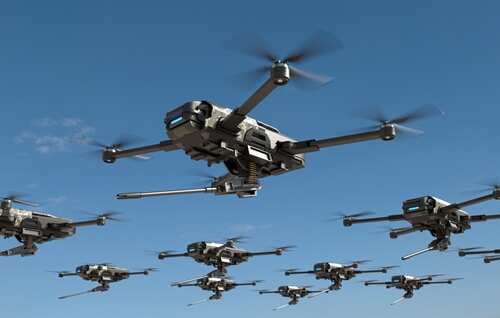
A fast-rising American drone maker just landed up to $500 million from the U.S. Army to mass-produce cheap attack drones built to overwhelm enemy defenses.
Story Highlights
- Reports say Neros won a U.S. Army deal worth up to $500 million for first-person-view attack drones.
- Neros’ chief executive says the company has shipped about 22,000 drones so far, mainly to U.S. forces.
- Defense Innovation Unit trials in Alaska reportedly showed Neros drones working against military jammers.
- No public Army contract document confirms the award details, leaving key terms unverified.
Army Turns To Low-Cost Swarm Power To Win Drone Wars
Reports from financial and defense outlets say the U.S. Army picked Neros Technologies for as much as $500 million to build first-person-view attack drones that soldiers can fly straight into targets. These drones are designed to be low cost and expendable. The move fits a wider Pentagon push to buy many simple systems fast, instead of a few gold-plated ones. That shift aims to counter mass-produced drones from foreign rivals who flood battlefields with cheap air power.
Neros, a California startup founded by former teenage drone racers, says it has already shipped about 22,000 drones, with most going to the U.S. Army and Marine Corps. The company’s chief executive describes a production ramp in Los Angeles that is moving from hand assembly to automation. He says the goal is six figures per year and, with time, even more. These targets show ambition, but they rely on the company’s own statements and lack third-party audits so far.
Electronic Warfare Is The New High Ground
Defense Innovation Unit testing in Fairbanks, Alaska, reportedly showed Neros drones operating despite jamming, including from a backpack-style jammer in 2023. If that result holds at scale, it matters. Adversaries invest heavily in electronic warfare to blind or break drones. The U.S. must field systems that can fight through this threat. Robust links, smart routing, and hardened control signals help keep pilots in the fight when the airwaves get hostile.
Leaders across the services see that cheap drones change tactics fast. Units can scout, strike, and harass at low cost and high tempo. That edge fades if you cannot produce by the tens of thousands. The chief executive says Neros aims to pass 100,000 units per year as capacity grows. Those numbers, if proven, would mark a step toward industrial scale. Until independent verification or official delivery data appears, output claims remain unconfirmed.
Big Promise, Real Gaps: What We Know And What We Do Not
ZeroHedge and Seeking Alpha both report the deal value at up to $500 million, but the Army has not released a contract number or a public notice to confirm the ceiling, unit pricing, or delivery schedule. That lack of an official document leaves room for error on details. However, no major outlet or official has offered a direct, on-record refutation of the reported award. For now, the core claim stands as reported but not yet documented by an Army release.
Neros Technologies has secured a U.S. Army contract worth up to $500 million to supply first-person-view attack drones, marking one of the Pentagon’s largest FPV drone awards to date. #USA #FPV #Drone #Defense pic.twitter.com/WexmSvmLEx
— Drone Wars (@Drone_Wars_) July 15, 2026
For conservatives, three tests matter. First, does this buy strengthen American troops against China, Iran, and their proxies? Second, does it deliver value over waste? Third, does it rebuild U.S. industry at home? Low-cost, American-made drones move toward yes on all three—if production is real, performance is verified, and oversight is tight. Congress and the administration should press for formal test data, on-time deliveries, and clear cost-per-unit reporting to protect taxpayers and the mission.
Sources:
zerohedge.com, natsecpulse.com