

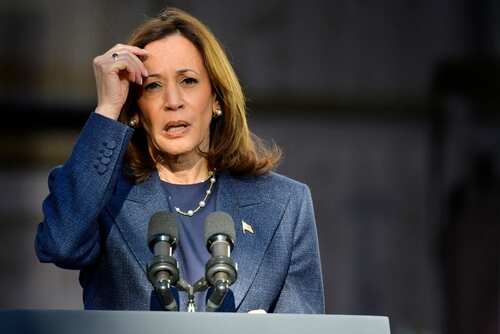
Kamala Harris’s bold remarks on President Trump spark heated debates, showcasing the dangerous rhetoric that threatens to divide America further.
Story Highlights
- Kamala Harris calls President Trump a “dictator” and “tyrant” on MSNBC.
- No evidence supports claims of Charlie Kirk’s assassination.
- The rhetoric intensifies partisan divisions ahead of the 2025 election.
- Critics argue such language is hyperbolic and undermines democratic discourse.
Kamala Harris’s Bold Statements on Trump
In a recent interview on MSNBC with Rachel Maddow, former Vice President Kamala Harris described President Donald Trump as a “tyrant” with a “fragile ego” and compared the state of American democracy under Trump to that of “communist dictators.” These statements have sparked intense reactions across the political spectrum, further highlighting the deep partisan divides that characterize the 2025 presidential campaign.
Harris’s remarks come at a time when the political rhetoric is reaching new heights, with accusations of authoritarianism frequently leveled against political opponents. The use of such severe language by a prominent Democratic leader underscores the heightened tensions and the stakes involved in the upcoming election. However, it is crucial to note that the claim regarding conservative leader Charlie Kirk’s assassination is unfounded and appears to be a fabricated narrative.
Media Reactions and Public Discourse
The media has been quick to react to Harris’s statements, with some commentators criticizing the language as exaggerated and inconsistent. Outlets like Sky News Australia have questioned the shifting labels applied to Trump, suggesting that such rhetoric may undermine the credibility of the critics. Meanwhile, mainstream news platforms like USA Today and AOL have reported on Harris’s interview factually, focusing on the content of her statements without endorsing or refuting her claims.
The impact of this rhetoric is evident in the increased polarization among partisan bases, as media amplification of terms like “dictator” and “tyrant” continues to influence public discourse. This environment of heightened controversy benefits the media industry but poses risks to democratic institutions, as extreme language can erode trust and make bipartisan cooperation more challenging.
The Broader Implications of Political Rhetoric
In the long term, the use of extreme rhetoric in political debate may contribute to the erosion of trust in democratic institutions. Scholars of democracy warn that repeated accusations of authoritarianism, if unsupported by evidence, can lead to democratic backsliding. As the 2025 presidential campaign progresses, it remains critical for both political leaders and media to engage in responsible discourse, focusing on facts rather than sensationalism.
As voters head to the polls, they must sift through the noise and focus on the substantive issues that will shape the future of American democracy. The role of the media and political leaders in fostering a healthy democratic environment cannot be overstated, and it is incumbent upon them to prioritize truth and integrity in their communications.
Sources:
USA Today – Kamala Harris knocks Trump as a ‘tyrant’ in Maddow interview
AOL – Harris: Trump dealing like a communist dictator