

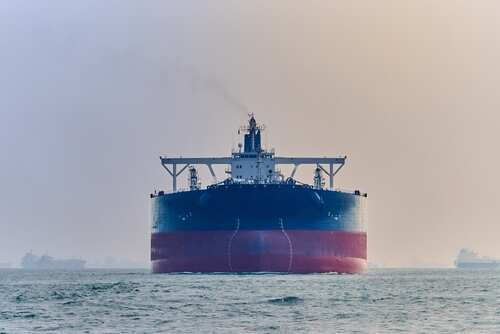
Iran’s Strait of Hormuz disruption is sending “completely empty” supertankers racing toward America—because when the world’s energy lifeline gets squeezed, U.S. oil suddenly becomes the emergency backstop.
Quick Take
- President Trump says “massive numbers” of empty tankers are heading to the U.S. to load crude oil and natural gas.
- The rush follows major disruption in the Strait of Hormuz, a key global chokepoint for traded oil.
- Brent crude climbed to about $97, up more than 30% since late-February conflict began, reflecting supply shock.
- Reports cited in coverage say “at least 100” empty tankers with roughly 2 million barrels capacity each may be repositioning toward the U.S. Gulf Coast, though exact counts remain fluid.
Trump’s claim: Empty tankers inbound to load U.S. oil and gas
President Donald Trump said in early Saturday Truth Social posts that “massive numbers” of completely empty oil tankers—some of the largest in the world—are heading to the United States to “load up” with American crude oil and natural gas. The announcement, timed as Vice President JD Vance traveled overseas for high-level peace negotiations, frames U.S. energy production as the immediate substitute when overseas supply routes get throttled.
https://www.youtube.com/@TanksOnEmpty/videos
Trump also described American crude as the “best” and “sweetest” oil, arguing the U.S. has more oil than the next two largest oil economies combined and at higher quality. Those are political claims, but the market response described in reporting is concrete: empty vessels repositioning toward U.S. ports typically signals expectation of strong loading demand and attractive export economics, especially when global benchmarks spike.
Why the Strait of Hormuz matters—and why closures ripple into U.S. ports
The Strait of Hormuz has long been one of the world’s most critical energy chokepoints, historically moving roughly one-fifth of globally traded oil. Prior to the disruption, more than 100 ships reportedly transited daily, many destined for Asian customers that rely heavily on Persian Gulf supplies. When commercial vessels avoid that narrow corridor, it doesn’t just change shipping routes—it forces refiners and governments to hunt for replacement barrels elsewhere.
Reporting tied the current tanker scramble to Iran’s closure of the Strait during a conflict that began in late February. After a ceasefire, only about a dozen vessels were recorded transiting, according to coverage citing the Associated Press. The constraint coincided with a sharp price reaction: Brent crude, the international benchmark, traded around $97 on Friday, up more than 30% since the conflict began. That kind of move tends to pull spare supply—and spare shipping—toward the least risky loading points.
What “at least 100” empty tankers could mean—and what remains unverified
Analysis referenced in the coverage suggests at least 100 empty tankers with approximately 2 million barrels of capacity each could be moving toward the U.S. Gulf Coast, implying an enormous potential lift in export throughput. The same reporting indicated some tankers were already positioned around the Cape of Good Hope and in the Atlantic, effectively reorienting away from the Middle East route. However, the exact ship count and load schedule should be treated as developing information.
Trump highlighted “quick turnaround” for loading and unloading, which points to a push for rapid export cycles rather than slow, long-term storage. Operationally, that would depend on port availability, pipeline flows, and refinery or terminal capacity along the Gulf. The reporting also notes a complicated reality of global supply: some cargoes bound for Asia could include blends from multiple origins—American crude and, in some cases, Venezuelan crude processed through U.S.-linked supply chains—making verification of exact composition essential as manifests emerge.
Energy security lesson: chokepoints invite leverage, domestic production reduces it
The immediate policy takeaway is straightforward: reliance on overseas chokepoints creates leverage for hostile or unstable actors, while robust domestic production and export capacity can blunt the damage. Market watchers quoted in coverage argued the U.S. is positioned to mitigate the crisis by supplying oil as other routes tighten. From a constitutional, limited-government perspective, the most durable protection is not bureaucratic micromanagement, but reliable American output and infrastructure that can respond fast.
For U.S. households still frustrated by years of energy-price whiplash and inflationary pressure, the near-term question is whether increased U.S. export flows stabilize global pricing enough to ease broader cost pressures—or whether global turmoil keeps the premium baked in. Reporting also says Trump described efforts to clear the Strait of Hormuz as “a favor” to other countries. That underscores the geopolitical reality: when America has surplus energy capacity, Washington can influence outcomes without surrendering sovereignty.
BREAKING: Empty Oil Tankers Are Racing to the US for Oil https://t.co/Cnlp4oTMrL
— Frank46 (@Frank461985941) April 12, 2026
For now, the strongest confirmed facts are the President’s statement that empty tankers are inbound to load in the United States, the documented disruption in Hormuz traffic, and the significant jump in Brent prices. The rest—exact tanker counts, precise timing, and the full downstream impact—will be verified in coming days as shipping data, port activity, and export figures clarify how large this U.S. loading wave really becomes.