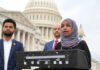

The Supreme Court’s liberal women justices keep fighting to reshape women’s sports and immigration, even as a conservative majority pushes back to protect fairness and security.
Story Snapshot
- The Supreme Court upheld state bans on transgender athletes in girls’ and women’s sports, by a 6–3 vote.
- All three liberal women justices dissented, arguing there is not clear proof that biological males have an inherent advantage.
- In a separate case, the Court allowed President Trump to end Temporary Protected Status for Haitian and Syrian migrants, again 6–3, with the liberal women justices in dissent.
- These rulings show a sharp split: conservatives backing state power, border control, and women’s sports; liberals pushing expansive ideas of “rights” that often clash with those goals.
Supreme Court Backs States on Transgender Athletes
In January 2026, the Supreme Court ruled 6–3 that states can enforce bans keeping biological males out of girls’ and women’s sports teams. The cases from Idaho and West Virginia challenged laws that sort school sports by sex recorded at birth. Justice Brett Kavanaugh wrote the majority opinion, stating the Constitution and Title IX do not require a complete restructuring of women’s and girls’ sports. For many parents and coaches, this was a vital win for fairness, safety, and common sense in school athletics.
The three liberal women justices — Sonia Sotomayor, Elena Kagan, and Ketanji Brown Jackson — all dissented. Justice Sotomayor argued the Court was rushing to shut down claims from “disfavored groups” and said there was “insufficient evidence” that transgender girls and women have a universal inherent physical advantage. Justice Kagan pressed lawyers on how to craft a ruling that kept bans in place yet still gave transgender athletes access in some form. Their stance backed more inclusion for transgender athletes, even though states and many parents worried about biological differences and fairness for girls.
Liberal Dissent Versus Women’s Sports and State Authority
Reports from major outlets like NBC News and the San Francisco Chronicle make clear that the conservative majority, not the liberals, upheld the bans. The liberals did not write the rules that protect girls’ sports; they opposed those rules. Critics on the left frame their dissent as defending “civil rights,” but for many families, allowing biological males into girls’ teams looks like an attack on hard-won opportunities for women. The ideological divide is about what “equality” means, and who pays the price when elite theories collide with everyday realities.
Legal scholars and advocacy groups such as the American Civil Liberties Union describe the liberal justices’ position as standing up for transgender students who feel excluded. They highlight data suggesting no simple, categorical athletic advantage for transgender female athletes over all other women. But parents watching their daughters lose scholarships or face safety risks see something very different. They see a Court minority that treats biological sex as a negotiable detail and pushes social experiments onto girls’ leagues and school gyms. The conservative majority, for now, is the firewall against that pressure.
TPS Ruling: Border Security, Humanitarian Concerns, and Ideological Lines
In June 2026, the same 6–3 ideological split appeared in immigration. The Court upheld President Trump’s decision to end Temporary Protected Status for Haitian and Syrian migrants, reversing lower courts that tried to block him. The majority held that the administration had authority to wind down TPS, which many conservatives see as a program that was meant to be temporary but became a back door to long-term presence. Once again, the three liberal women justices dissented, arguing against ending those protections.
The Supreme Court ruled 5-4 that states can accept mail-in ballots after Election Day, with Justices Barrett and Roberts joining the liberal bloc. This allows states like California to continue counting ballots for weeks after polls close.
The decision underscores ongoing… pic.twitter.com/uVP88XLJ30
— Dick Hammer (@DickHammer776) June 29, 2026
Justice Sotomayor’s dissent in the TPS case backed keeping those migrants in the United States under humanitarian grounds. Her reasoning reflected a broader liberal view that leans toward expansive protections for foreign nationals, even when Congress and the administration try to restore order to the system. For border communities and working Americans, long-running TPS programs can look like another path toward endless inflows and pressure on jobs, schools, and services. The conservative majority’s ruling aligned with the Trump administration’s effort to regain control and end “temporary” programs that never seem to expire.
Is the Real Divide Gender or Ideology?
Some critics say “liberal women” on the Court are the main hurdle to restoring fairness in sports and sanity in immigration. The record shows something more precise: every liberal justice, who all happen to be women in this era, lined up on the side of transgender inclusion in girls’ sports and extended protections for foreign migrants. Research on women in the judiciary notes that female judges often bring strong perspectives on equality and rights into their work. In these cases, that lens led the liberal justices to resist limits many Americans see as basic common sense.
At the same time, academic studies remind us that ideology, not only gender, drives these splits. Conservative justices have consistently interrupted and opposed liberal colleagues during oral arguments. Liberal jurisprudence often focuses on stretching rights claims, while conservative jurisprudence stresses text, history, and limits on government power. For Trump supporters who care about family, faith, and the Constitution, the concern is less that the dissenters are women and more that their legal vision keeps pushing radical social change into places like school sports and immigration policy, over the wishes of voters and state lawmakers.
Sources:
youtube.com, nbcnews.com, sfchronicle.com, politico.com, aclu.org, bbc.com, facebook.com, idlo.int, facultygovernance.mit.edu, unodc.org, hiil.org