

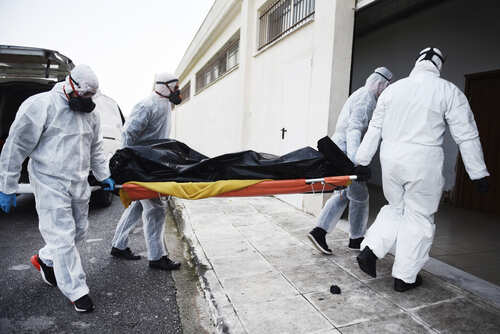
More than 50 bodies sat in a Chicago funeral home in conditions that turned a quiet neighborhood complaint into a public horror story.
Story Snapshot
- Officials said investigators found more than 50 bodies in various stages of decomposition at South Chicago Chapel on the city’s Southeast Side.
- Chicago police said they entered the funeral home during a licensing investigation requested by the Illinois Department of Financial and Professional Regulation.
- State regulators suspended a funeral director’s license after describing rodent infestation, maggot infestation, and unrefrigerated storage.
- Neighbors said they had smelled a foul odor for months, which helped bring attention to the site.
What Officials Found Inside
Chicago police responded to South Chicago Chapel at 2939 E. 95th St. around 2 p.m. on Thursday to assist the Illinois Department of Financial and Professional Regulation with a licensing investigation. When officers arrived, they found human remains on the property. The Cook County Medical Examiner’s Office later said more than 50 bodies were found in various states of decomposition, and staff were still checking records and death certificates to identify the dead.
Multiple reports said the remains were found in basement and attached garage areas, which made the scene look less like a simple storage mistake and more like a deep breakdown in basic funeral-home handling. The Cook County Medical Examiner’s Office said the identification process could take several days, which shows how large and messy the recovery effort became.
The Licensing Case Behind the Scene
The strongest thread in the record is not just the odor complaint. It is the regulatory failure. CNN reported that state records described the funeral director’s continued practice as a danger to public safety, interest, and welfare because multiple decedents were kept in an unrefrigerated area with deplorable conditions, including rodent infestation and maggot infestation. That language matters because it shows officials were not treating this as a minor code issue.
AP reporting also linked the funeral home operators to a prior crematory that had been shut down over mishandled remains. That history does not prove this case by itself, but it explains why the discovery landed with such force. When the same names appear again in a body-handling scandal, people assume a pattern before the paperwork is even finished.
Why Neighbors Knew Something Was Wrong
Neighbors had been complaining about a strong smell for months, and some said the odor was unbearable. One AP account quoted residents describing a smell so strong that it made people want to vomit. That kind of language is not casual gossip. It is what happens when a neighborhood starts to notice that something organic has gone very wrong, long before the state has a clean official explanation.
More Than 50 Decomposing Bodies Found at South Chicago Chapel Funeral Homehttps://t.co/a1xAM2uoMi pic.twitter.com/Pha2o4S8Kt
— Paul (@pjones461) August 8, 2026
Still, the public record provided here does not fully show every complaint, every date, or every official response. That missing paper trail leaves one important question open: how long did regulators or local officials know, and what happened after the first warnings? What is already clear is that this was not a single bad day. It was a breakdown that smelled bad, looked bad, and, by every official account so far, got worse over time.
What Makes This Case So Damaging
Funeral homes rely on trust more than most businesses. Families hand over the dead and assume the professionals will treat them with care. That is why this story hits so hard. If the reported facts hold, the violation was not only sanitary. It was moral. The business of death depends on dignity, and officials say that is exactly what was missing here.
The public will remember the shocking body count first. But the deeper story is the slow failure that led to it. A complaint. A license probe. A walk-through. A room full of remains. Then the grim work of identification. That sequence tells its own story, and it is the kind of story that does lasting damage to a whole community’s trust in the system meant to protect the dead.
Sources:
youtube.com, facebook.com, nbcchicago.com, wgntv.com, cnn.com, chicagotribune.com, instagram.com