

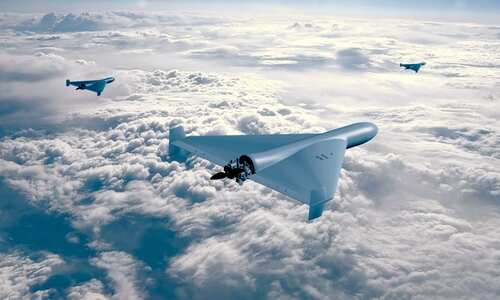
Two huge stealth flying-wing drones just showed up in the open at China’s Malan test base, and one looks B-2 sized.
Story Snapshot
- Commercial satellites caught two large stealth drones on Malan’s tarmac on March 26, 2026.
- Analysts say the larger design, nicknamed WZ-X, rivals the B-2 in wingspan.
- Malan in Xinjiang hosts China’s most secretive aerospace testing.
- The images point to a push for long-range, stealthy surveillance and strike.
What The New Images Show And Why It Matters
Commercial images dated March 26, 2026 show two very large, stealthy flying wings parked on the main apron at Malan, a remote test base in China’s Xinjiang region. The larger airframe matches what watchers call WZ-X. The second appears to be another high-altitude, long-endurance stealth drone. Both sat outside their hangars at the same time, which signals active testing. Public shots of two such aircraft out in the open at Malan are rare, and that is the headline.
Open-source analysts compare the larger airframe’s span to the United States B-2 bomber’s 172-foot wingspan and place WZ-X around the same size. A drone that large, with a flying-wing shape and edge alignment, points to a focus on low radar signature and long endurance. The size also hints at volume for fuel, sensors, and possibly internal bays. That mix suggests roles like deep surveillance, electronic warfare, or even a strike option if a payload bay exists.
Malan’s Role In China’s Black Projects
Malan has long ties to China’s most sensitive work. Reporting describes it as a People’s Liberation Army Air Force test center known for advanced aircraft and uncrewed systems, far from dense air traffic and prying eyes. Earlier imagery in 2025 first tied a large low-observable flying wing to the site, anchoring a timeline of steady activity through 2026. Seeing two large stealth drones staged together strengthens the case that this is more than a one-off prototype and could be a family of related designs.
Analysts note planform cues beyond size. Some imagery and analysis describe a “cranked-kite” style wing on one variant, where the inner wing and outer panels break at an angle to manage lift, drag, and radar signature across flight regimes. That shape, seen on Western concepts, aims to blend efficiency with low observability. If China is testing multiple wing planforms at Malan, engineers are likely tuning stability, fuel fraction, and sensor fields of regard for different mission sets.
What The Program Could Deliver Next
Two aircraft on the ramp on the same day suggest envelope expansion and ground integration tasks are underway, like engine runs, datalink checks, and taxi trials before longer flights. A platform this large could orbit for many hours over the open ocean, track ships, map air defenses, and feed targeting data across the kill chain. If a strike variant follows, it could pair with standoff weapons for long-range, low-risk attacks. That would extend China’s reach well into the Pacific.
American planners care about this for clear reasons. Stealthy, high-endurance drones shrink warning time and stretch thin the sensor networks that guard carriers and forward bases. They also complicate deterrence. A rival that can see farther and strike first changes behavior in a crisis. The common-sense response is to harden logistics, disperse forces, and grow counter-stealth sensing, including passive radio-frequency networks and infrared search systems that do not rely only on radar.
How To Read The Evidence With Clear Eyes
Satellite images show what is on the ground. They do not reveal range, payload, or software maturity. But repeated sightings at Malan across 2025 and 2026, the unusual size of the main airframe, and the visible low-observable shaping justify a firm bottom line: China is fielding very large, stealthy, long-endurance drones and is moving them through visible test steps. The unofficial WZ-X name is a label from observers, not a formal designation, but the aircraft is real and growing more active.
China’s Huge WZ-X Stealth Drone’s Strange Wing Configuration Confirmed
New imagery appearing out of China provides the best look yet at one of the country’s most enigmatic aircraft: the very large, low-observable, flying-wing drone widely referred to as the WZ-X . Seen… pic.twitter.com/8ST268Pc4l
— Armed Forces Press (@AFP_press) September 5, 2026
Policy should track the facts, not the hype. The facts say China is building the plumbing of modern airpower: survivable sensors with the legs to patrol the first and second island chains and beyond. The United States and allies should speed up their own unmanned teams, make refueling and basing agile, and practice with attritable drones that can soak up risk. Strength that is seen and tested in the open is what deters miscalculation and keeps the peace.
Sources:
zerohedge.com, meta-defense.fr, migflug.com, aerospaceglobalnews.com, nationalsecurityjournal.org, twz.com