

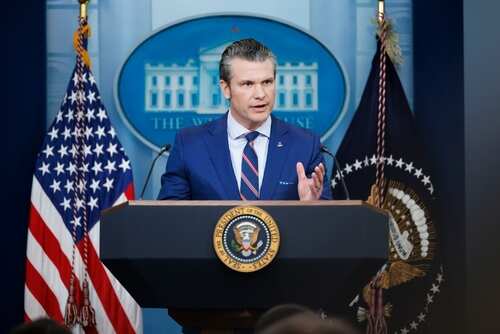
Pete Hegseth just drew a hard line against another endless-war trap: no U.S. boots on the ground in Iran—unless America has to go further to finish the job.
Quick Take
- Defense Secretary Pete Hegseth told 60 Minutes there are currently no U.S. ground troops in Iran during the ongoing campaign.
- Hegseth said the Trump administration is prepared to escalate “as far as we need to go” to meet military objectives.
- U.S. goals described in the reporting focus on degrading Iran’s missiles, drones, naval threats, and nuclear program—without nation-building.
- Hegseth warned that outside support for Iran’s war effort—amid reports involving Russia—will be “confronted strongly.”
Hegseth’s Message: No Ground War—But No Handcuffs Either
Secretary of Defense Pete Hegseth used a March 6, 2026, 60 Minutes interview to state plainly that the United States has no boots on the ground in Iran at this time, even as the military campaign continues. At the same time, he emphasized that the Trump administration will not lock itself into artificial limits if conditions change. The message: the U.S. is acting with clear objectives, not open-ended commitments.
That distinction matters after years of voter fatigue from foreign-policy missions that drifted into permanent deployments. The material in the research describes the current approach as operationally focused—built around targeted actions and assessments rather than occupation. Hegseth contrasted this posture with the kind of long-duration footprint Americans remember from past conflicts, signaling a doctrine aimed at decisive outcomes while avoiding the mistakes that turned “limited” missions into generational burdens.
What the Campaign Is Aimed At, According to the Available Reporting
The reporting tied to Hegseth’s public remarks describes objectives centered on Iran’s long-range strike and power-projection tools: missile forces, drones, naval capabilities, and nuclear-related infrastructure. It also notes named operations discussed in coverage, including “Midnight Hammer,” framed as precise action against nuclear capabilities after diplomacy failed. The research indicates U.S. Central Command is balancing offensive operations with ongoing assessments, which can delay a complete public accounting of results.
Russia’s Shadow Over the Conflict—and the Warning to Outside Enablers
A major flashpoint in the interview was the report that Russia may be providing intelligence that helps Iran track U.S. positioning. In response, Hegseth said the U.S. is monitoring events and will act against activity that “shouldn’t be happening,” warning that anyone enabling Iran’s war effort will be “confronted strongly.” The research also notes he downplayed the operational danger, arguing the U.S. is aware of threats and can mitigate them.
Clarifying the “Boots on the Ground” Controversy
The headline framing circulating online suggests the administration “reserves the right” to deploy ground forces. The research, however, is more precise: Hegseth said there are no U.S. boots on the ground right now, while also asserting the U.S. will go as far as needed to meet objectives. That leaves room for escalation in theory, but it is not the same as announcing an imminent ground invasion, and the provided material does not show evidence of current ground deployment.
Why This Lands Differently After the Biden Era
For many conservatives, the underlying test is whether Washington can protect Americans and allies without sliding into another expensive, open-ended commitment. The research frames the Trump administration’s posture as rejecting large-scale, long-term occupation while still projecting strength and deterrence. What remains unclear from the available material are concrete metrics—damage assessments, timelines, and casualty figures—because the campaign is ongoing and the reporting cited emphasizes simultaneous operations and evaluation.
Hegseth Tells 60 Minutes the Trump Admin Reserves The Right to Put Boots on the Ground in Iran: 'We're Willing to Go As Far As We Need' https://t.co/TCTOCsbwue pic.twitter.com/ZftCMJ1UYJ
— Mediaite (@Mediaite) March 9, 2026
The other unresolved question is how the situation evolves if Iran’s capabilities are not sufficiently degraded by air, maritime, and other stand-off actions. Hegseth’s comments, as summarized in the research, appear designed to deter both Iran and any external backers by keeping U.S. options open, while also reassuring Americans that this is not being presented as a new nation-building project. The administration’s next steps will likely depend on battlefield assessments not fully public yet.
Sources:
Hegseth says anyone helping Iran’s war efforts will be “confronted strongly”
Pete Hegseth appears mock Iranians