
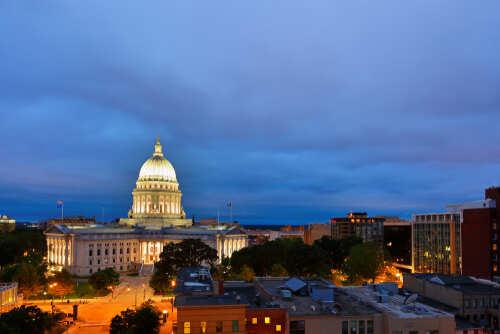
Wisconsin voters just locked in a liberal-controlled state Supreme Court that could decide abortion policy, union fights, and election maps for a decade—whether the race was “nonpartisan” or not.
At a Glance
- Susan Crawford defeated Brad Schimel in Wisconsin’s April 1, 2025 Supreme Court election, keeping a 4-3 liberal majority.
- Results were projected at roughly 55% for Crawford to 45% for Schimel, and the winner receives a 10-year term.
- Outside money and national political figures helped turn the contest into what outlets described as the most expensive judicial race in U.S. history.
- The court’s direction matters for abortion law after the post-Roe shift to state-level battles, plus redistricting and labor disputes in a critical swing state.
Crawford’s Win Keeps the Court on a Liberal Track Through 2035
Dane County Circuit Judge Susan Crawford defeated Waukesha County Circuit Judge Brad Schimel in Wisconsin’s Supreme Court election held April 1, 2025, securing a 10-year term. Media projections put the outcome near 55% to 45%, and the result preserved the court’s 4-3 liberal majority rather than flipping it. Although the election is formally nonpartisan, both candidates were openly aligned with national political coalitions and outside groups that treated the seat like a high-stakes partisan fight.
High early voting signaled intense engagement well before polls closed, with reporting citing about 600,000 ballots cast ahead of Election Day. The contest drew attention from major political donors and national figures, with President Donald Trump and Elon Musk aligned behind Schimel while Barack Obama, George Soros, and Minnesota Gov. Tim Walz backed Crawford. The scale and visibility of that involvement underscored a bigger reality: state courts have become where political movements try to secure wins they cannot always achieve through legislatures.
Why a “Nonpartisan” Court Race Turned Into a National Proxy War
Wisconsin’s judicial elections have grown more ideological since the U.S. Supreme Court returned abortion policy to the states, shifting many defining disputes to state constitutions and state supreme courts. That dynamic helps explain why this race was described as the most expensive judicial contest in U.S. history, fueled by massive outside spending. For conservatives, the frustration is familiar: issues that should be settled by elected lawmakers are increasingly fought through courts, with donors and activists treating judgeships as the final choke point.
The outcome also fits the pattern established in 2023, when liberals flipped Wisconsin’s Supreme Court to a 4-3 majority. With that margin intact, the court is positioned to keep shaping policy disputes that spill across state lines because Wisconsin is a presidential battleground. Reporting also highlighted how the court’s docket can affect congressional and legislative maps—one of the most consequential levers in politics—because map challenges can determine which party holds power even before a single campaign ad runs.
Abortion, Redistricting, and Labor Disputes Now Sit in the Court’s Lap
With Crawford’s victory, the court’s liberal majority remains in place during a period when state-level abortion law remains unsettled and frequently litigated. Coverage pointed to the possibility that the court could influence how Wisconsin treats older abortion restrictions and what access looks like going forward. The same majority is also expected to remain central in redistricting conflicts, a recurring Wisconsin flashpoint, because court rulings can reshape the political map and influence which party benefits in congressional races.
Labor disputes are another high-impact area likely to face legal challenges, especially where union policy, public-sector rules, or election administration are contested. These fights often turn on state constitutional interpretations rather than federal law, making a single state supreme court election unusually powerful. For conservatives focused on limited government, the concern is less about one case and more about the structure: when courts become the primary arena for policymaking, voters get less direct control and accountability becomes harder to trace.
What Conservatives Should Watch Next in Wisconsin’s High-Stakes Legal Battles
No recounts or legal challenges were highlighted in the available reporting, and the result was treated as finalized shortly after polls closed. Crawford’s post-election remarks emphasized her background in prosecution, law, and judging, framing her role as protecting rights for Wisconsin families. Observers also described the outcome as a political setback for Trump- and Musk-aligned efforts in the race, even though the election was not formally run under party labels.
The next major developments will come from the court’s calendar: watch for cases touching abortion policy, election rules, and redistricting, because those areas drive the biggest downstream effects on representation and cultural issues. The reporting provided limited specifics on exact spending totals and did not detail which cases will be heard first, but the broader takeaway is clear. Wisconsin’s Supreme Court remains a national battleground, and the state’s legal fights will continue to shape politics well beyond Madison.
Sources:
Wisconsin Supreme Court result: Susan Crawford wins
Crawford wins the 2025 Wisconsin Supreme Court election