
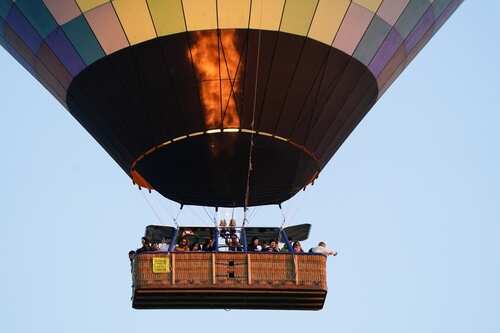
Two Texans dangled nearly 1,000 feet in the air after a hot air balloon slammed into a cell tower—and local firefighters climbed straight into the danger to bring them down alive.
Story Snapshot
- A hot air balloon basket became stuck roughly 920–1,000 feet up on a 1,100-foot cell tower in northern Gregg County, Texas.
- Longview Fire Department’s Special Operations Unit climbed the tower, secured two occupants, and lowered both without reported injuries.
- Rescuers began climbing around 8:50 a.m. and made contact with the occupants around 10:00 a.m., with the overall rescue completed in under four hours.
- Officials said windy conditions caused the basket to sway, raising the risk level and complicating the technical rope operation.
Balloon Basket Lodges High on a Gregg County Cell Tower
Gregg County authorities responded Saturday, February 28, 2026, after a hot air balloon collided with a cell tower near Texas 300 and FM 1844 in northern Gregg County. Reports put the basket’s position at roughly 920 feet, with some describing it as close to 1,000 feet. The tower itself stands about 1,100 feet. The two occupants were stuck in the basket, conscious, and reported uninjured as rescuers prepared a high-angle plan.
Longview Fire Department’s Special Operations Unit—drawing personnel from Stations 2 and 5—took command and started climbing operations around 8:50 a.m. Fire Marshal Marcus Delaney described the response as a “pretty smooth operation,” crediting training and coordination. Even so, the scale was unusual: many departments train for tower rescues at far lower heights, and climbing nearly a thousand feet with gear turns every step into a test of endurance and focus.
High-Angle Rescue Required Climbing, Rigging, and Controlled Lowers
Firefighters used multiple rope systems and a technical “leapfrogging” method—placing rescuers at different points on the structure—to manage anchors, lines, and patient movement. The cell tower’s central ladder, running the full height, made a physical climb possible, but it did not remove the danger. Wind contributed to the basket’s swaying, which can turn a simple transfer into a risky, moving target. Crews prioritized keeping the occupants stable and calm while securing them for the descent.
By about 10:00 a.m., firefighters made contact with the two occupants and confirmed they were conscious and cooperative, a key factor in any technical rescue at extreme height. Officials later shared a more detailed timeline: the first person was secured inside the tower around 10:29 a.m., and the second around 10:58 a.m. After that, the operation shifted from access to extraction—lowering each person methodically, with safety checks repeated at each transition point.
A Fast Timeline for a Rare Rescue—With Key Unknowns Remaining
Rescuers and outside specialists pointed out that tall-tower operations can stretch six to seven hours for a single patient in some historical cases. In this incident, officials described the overall operation as taking under four hours for both occupants, with the rescuers then making the long descent themselves. What remains unclear in public reporting is the cause of the balloon’s collision, whether mechanical issues played a role, and who operated the balloon. Authorities did not identify the occupants.
Why This Story Resonates: Competence, Community Trust, and Real-World Risk
Residents gathered near the site as the rescue unfolded, a reminder that public safety is often performed under intense, real-time scrutiny. Road impacts were reported as relatively minor, but the potential consequences were not. A fall from that height would almost certainly be fatal, and a swinging basket can threaten both victims and rescuers. For many Americans tired of institutions that feel ideological or performative, this was the opposite: trained professionals doing hard, physical work with a clear mission.
Trapped hot air balloon passengers saved in heart-stopping rescue at nearly 1,000 feet above ground https://t.co/LczapIgySV pic.twitter.com/goyjMh24PB
— New York Post (@nypost) March 2, 2026
Longview Fire Department finished the rescue with no reported injuries to the occupants or to the firefighters who climbed and rigged the tower. A separate crew was expected to handle balloon removal overnight into February 29, according to reports. Longer-term changes—like stricter ballooning guidance around tall towers or expanded high-altitude training—were discussed as possibilities, but no formal policy updates were confirmed in the available reporting. For now, the bottom line is straightforward: two people went up trapped, and came down alive.
Sources:
2 occupants rescued after hot air balloon hits, gets stuck on Gregg County cell tower