
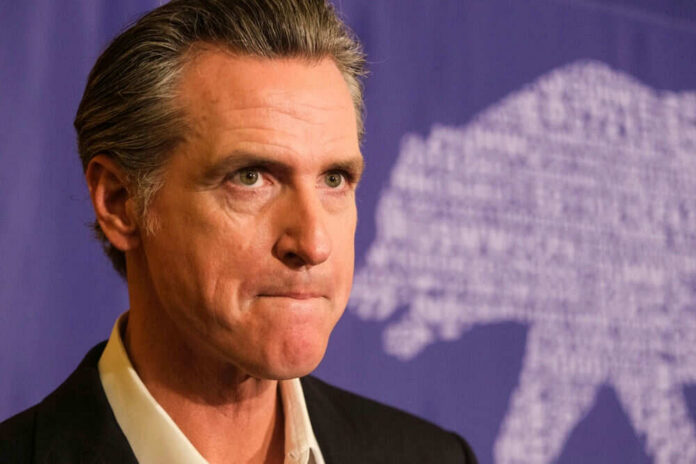
California Gov. Gavin Newsom went overseas and effectively told America’s allies to treat the elected U.S. president as a passing inconvenience.
Story Snapshot
- Gavin Newsom used the Munich Security Conference to argue that “Donald Trump is temporary” and that California—not Washington—should be viewed as a “stable and reliable partner.”
- Newsom attacked Trump’s energy and climate rollbacks, including a claimed recent reversal tied to the federal “endangerment finding,” and he urged leaders to push back publicly rather than privately.
- Newsom presented California’s record as proof of his policy approach, citing economic growth alongside emissions reductions and a clean-energy-heavy job mix.
- Only one primary source was provided; key claims about federal actions and political donations are presented as Newsom’s assertions, with limited external verification available in the supplied research.
Newsom’s message in Munich: Look past Washington and lean on California
Gavin Newsom delivered his remarks on February 13, 2026, at the Munich Security Conference, a global gathering focused on security issues that increasingly includes climate. Newsom’s central line—“Donald Trump is temporary”—framed his pitch to international leaders: treat California as a consistent partner even if the White House changes course. He said Trump would be “gone in three years” and contrasted federal volatility with state-level continuity.
Newsom’s approach matters because it elevates “subnational diplomacy,” where governors and state coalitions attempt to represent American policy preferences to foreign leaders. The research indicates he positioned California’s economy and regulatory model as a stand-in for national policy, leaning on the state’s size and reputation. That posture can create friction with the normal constitutional expectation that federal officials conduct foreign policy, even when governors travel and speak abroad.
What Newsom accused Trump of doing on energy and climate
Newsom accused President Trump of pursuing “destructive” climate policy driven by fossil-fuel interests, including reopening coal plants and weakening regulations. The research also says Newsom pointed to a very recent rollback connected to eliminating the climate “endangerment finding,” which underpins parts of federal greenhouse-gas regulation. Because the provided material centers on a single report of Newsom’s speech, the details of what changed “yesterday” are not independently documented here.
Newsom also alleged that campaign money and deregulation were linked, citing nearly “half a billion” in fossil-fuel-related contributions and claiming Trump was seeking even more. Those numbers appear in the research as part of Newsom’s talking points, not as a separate audit or filing review. Readers should treat them as allegations unless confirmed through public donation records or multiple independent reports, which were not included in the supplied source set.
California’s “proof points” and what they do—and don’t—show
To argue that progressive climate policy can coexist with prosperity, Newsom cited California metrics since 2000: 81% GDP growth and a 21% emissions reduction. He also claimed California has seven times more clean-energy jobs than fossil-fuel jobs. As presented, these statistics are intended to show that heavy regulation and clean-tech investment can scale without collapsing growth. The supplied research does not provide underlying datasets, methodologies, or definitions for “clean jobs.”
Even if the numbers are accurate, they do not settle the broader policy debate on affordability, grid reliability, and the cost of mandates across different states. California’s economy and geography are unique, and the research does not compare outcomes against other large states under different policy models. That limitation is important when a governor asks world leaders to treat a single state’s approach as a template for national direction.
The political subtext: positioning for 2026 and beyond
The research frames Newsom as motivated by national Democratic leadership ambitions while being term-limited as California governor in 2026. His Munich message doubled as international-stage branding: he cast Trump as an aberration and portrayed his own approach as the durable “future.” Newsom also urged corporate leaders and politicians to stop what he described as timid, private grumbling and instead oppose Trump openly, rejecting what he called performative diplomacy.
VIDEO – Gavin Newsom Savages Trump on CNN From World Conference — Says He’s Reminding Leaders ‘Trump Is Temporary!’ https://t.co/Q4ZHCxJSQi
— Grabien (@GrabienMedia) February 14, 2026
For conservatives, the key takeaway is not a climate argument but a governance signal: a major-state governor speaking abroad in a way that encourages foreign leaders to discount the legitimacy and staying power of the current administration. The provided research stops at the speech itself, with no additional reporting on how European leaders responded or whether federal officials addressed the remarks. With limited data beyond the event, the most verifiable fact remains the content and framing of Newsom’s public comments.