
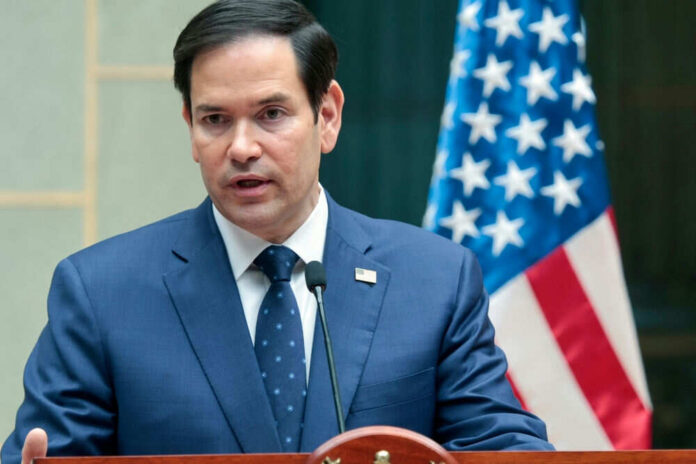
When legacy media tried to frame America’s Iran strikes as Israel “dragging” the U.S. into war, Secretary of State Marco Rubio shut it down—on camera.
Quick Take
- Marco Rubio confronted CNN’s Manu Raju after Rubio said reporters were misrepresenting his earlier remarks about why the U.S. struck Iran.
- Rubio argued the Trump administration chose the timing and objective—targeting Iran’s missile program, naval capability, and nuclear ambitions—rather than acting “because Israel did.”
- Reporting highlighted conflicting claims about the immediacy of Iran’s threats, including intelligence assessments that complicate simple “imminent” narratives.
- U.S.-Israel operations reportedly began Feb. 28, 2026, and accounts say Iran’s top leadership—including Ayatollah Ali Khamenei—was killed in the opening phase.
Rubio’s press exchange becomes a fight over who controls the narrative
Secretary of State Marco Rubio’s March 3, 2026, confrontation with CNN’s Manu Raju happened after Rubio briefed senators and walked through the Capitol’s Senate subway area, where reporters peppered him with shouted questions. Rubio objected to what he called selective quoting from his earlier comments about the strike decision. He insisted the administration’s case was being reduced to a simplistic claim that Israel compelled U.S. action.
Rubio’s core point was about agency and objectives: the United States, under President Trump, made its own decision on timing and scope, even while coordinating with Israel. In the exchange, Rubio pressed the media to use full context and let him finish answers, signaling frustration with gotcha-style questioning. He also raised a practical issue: Americans in the region who needed State Department contacts to get out safely.
What the administration says the strikes are meant to accomplish
Rubio and other officials have described a military campaign focused on degrading Iran’s ability to threaten the U.S. and allies—especially through missiles, maritime capability, and nuclear infrastructure. The broader backdrop includes years of escalating tensions tied to Iran’s ballistic missile development, its nuclear program, and the use of proxy forces across the region. Rubio’s stated rationale emphasized hitting capabilities that let Tehran “hide behind” missiles and drones while diplomacy stalled.
Defense Secretary Pete Hegseth has sought to draw a bright line between destroying Iranian military capabilities and pursuing open-ended “regime change,” describing the operation as decisive rather than endless. President Trump, meanwhile, has spoken about the need for Iranian “freedom,” but public messaging on duration has varied—from a matter of days to potentially weeks—creating uncertainty about end-state planning. Those differences matter because Americans remember how unclear objectives can expand conflicts.
Key facts—and real uncertainties—behind the “imminent threat” argument
Some reporting has highlighted tension between the administration’s urgent descriptions of threat and intelligence-related caveats. Accounts cite earlier assessments suggesting Iran could pursue an ICBM capability on a longer timeline and that there was not necessarily an active program aimed at striking the U.S. homeland right now. Other statements cited in coverage suggested Iran was dangerously close to nuclear breakout. These contradictions don’t prove bad faith, but they do show why clear, consistent public explanations matter.
Rubio’s own timeline is central to the dispute with reporters. His earlier remarks acknowledged the U.S. was aware Israel was prepared to act and that Iranian retaliation could have threatened U.S. forces in the region. On March 3, Rubio argued that acknowledging a regional trigger is not the same as saying Washington took orders from Jerusalem. The difference may sound technical, but it shapes whether the public sees the mission as U.S.-led strategy or reactive entanglement.
What the U.S.-Israel coordination means for American interests
Multiple accounts describe U.S. and Israeli strikes beginning Feb. 28, 2026, with joint operations reportedly killing Ayatollah Ali Khamenei and other senior officials early in the campaign. If accurate, that kind of “decapitation” strike can disrupt command-and-control quickly, but it also raises questions about escalation dynamics and what comes next inside Iran. Israeli assessments cited in coverage anticipate months of conflict, which could test American patience and resources.
For conservatives who prioritize constitutional government and national interest, the central question is whether U.S. goals remain narrow, achievable, and legally accountable to the American people through Congress and transparent briefings. Rubio’s public clash with CNN sits inside that larger debate: Americans deserve facts, not narratives—whether from officials overselling a case or media outlets compressing a complex timeline into a blame game that obscures U.S. decision-making and responsibility.
WATCH: Marco Rubio Puts CNN’s Manu Raju in His Place After the Liberal Hack Slyly Misrepresents Rubio’s Statement Regarding Iran and Israel https://t.co/73kglM37sj
— ConservativeLibrarian (@ConserLibrarian) March 4, 2026
As the strikes continue, the story to watch is not just battlefield damage assessments, but whether the administration’s messaging solidifies around a stable objective—destroying specific threat capabilities—without drifting into undefined nation-building. Rubio’s demand for full context may resonate with voters tired of media spin, but the administration will still need to keep its own explanations consistent if it wants durable public support for a high-stakes campaign.
Sources:
BOOM: Rubio Smokes Annoying CNN Hack Manu Raju Over Why U.S. Attacked Iran
Trump’s Iran war message marked by exaggerated threats and shifting contradictory goals
Israel believes Iran war could last months