
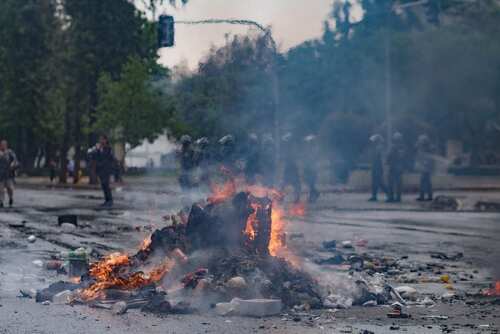
France’s president told local officials to be ready to stop protests when needed after city halls burned and arrests surged.
Story Snapshot
- Emmanuel Macron told prefects to work with mayors and, if needed, ban specific gatherings.
- Marches topped half a million nationwide; violence hit multiple cities and civic buildings.
- Interior officials blamed radical far-left groups for organized attacks.
- Paris issued partial protest-route bans while allowing modified marches.
What Macron Actually Ordered And Why It Matters
Emmanuel Macron addressed the country and told prefects to protect city halls, schools, and businesses, even by prohibiting certain protests when needed. He paired that with a pledge to hear public anger and act on its causes. This is not a national shutdown of protests. It is targeted authority to block gatherings judged likely to turn violent. The legal hook already exists in France’s internal security code; Paris used it the same weekend to alter march routes.
That nuance will not calm everyone. Many will hear “ban” and think “rights at risk.” The law-and-order case rests on scale and method. Police and reporters counted violence across several cities, with masked groups striking civic sites, including city halls, and setting fires. The Limoges City Hall roof partly collapsed after a blaze, turning a symbol of local democracy into a cautionary image on looped video. When state symbols burn, politicians reach for stronger tools.
The Scale And Spread That Forced The Issue
Demonstrations drew about 550,000 people across France in one day, according to contemporaneous reporting. Most marched peacefully. A smaller share clashed with police, looted, and hit public offices and shops. Newsrooms logged arrest counts that jumped as the night wore on, from hundreds to more than a thousand, reflecting different cutoffs and regions. That variance clouds the math, but not the picture: this was large, fast, and hard to police in real time.
Officials framed the violent actors as organized and highly aggressive. The interior minister backed police use of intermediate weapons if urban violence erupted, citing the need to keep streets and public buildings under control. That tracks with the conservative instinct that order is the floor for every other freedom. When offenders attack city halls and schools, a serious government isolates the threat and keeps room for peaceful protest to proceed.
Rights, Risks, And The Narrow Path Between Them
Macron’s message carried a split-screen: defend the constitutional right to protest, and punish those who smashed, burned, or looted. He said prosecutors would use the full force of the law. He also told ministers to meet with students, teachers, unions, and others to address the drivers of unrest, like high living costs and poor school conditions. This is the classic two-track approach: talks for grievances, cuffs for arsonists.
Critics will ask where the line sits between a prudent, targeted curb and a creeping rule that chills dissent. That is the right question. The best check is transparency and tight tailoring: name the route, explain the risk, show the intelligence, and set an expiration. Paris’s partial bans, paired with alternate routes, offer the template. The state should also publish timely arrest data with locations and charges to avoid dueling narratives fed by shifting totals.
What Comes Next If The Fires Go Out
If authorities contain the violent flank and keep most marches open, the political fight shifts to results. Talks must land quick, concrete fixes that meet public concerns without rewarding mayhem. That means targeted help on school safety and upkeep, clear timelines on cost-of-living relief, and visible protection of small businesses that took the hits. Anything less feeds the cycle where each new riot begets a new restriction, and trust erodes on both sides.
FRANCE IN TURMOIL: STUDENT PROTESTS, MASS ARRESTS AND A POLITICAL BATTLE FOR THE FUTURE!
France is facing renewed political and social tensions, with reports of hundreds of students injured and thousands arrested amid protests across the country.
But beyond the streets, another…
— JerryXHub💫 (@JerryXhandle) October 18, 2026
France has lived through this pattern before. Riots make dramatic images but often lead to muddy policy outcomes. Voters reward whoever pairs control with competence. On this count, common sense aligns with conservative values: keep streets safe, protect the right to peaceful protest, punish criminals fast, publish the facts, and fix what can be fixed. If the government sticks to that order, bans will stay rare, and the Republic will feel steadier by the next weekend.
Sources:
gpb.org, cnbc.com, bbc.com, cnn.com, euronews.com