
California’s own rules let people register to vote without a driver’s license or Social Security number, raising fresh alarms about election integrity in a high-stakes year.
Story Highlights
- State guidance allows registration without a driver’s license or Social Security number by assigning a unique identifier.
- Most California voters are not asked to show identification at the polls, except in limited first-time cases.
- First-time voters who registered by mail without key numbers may show non-photo documents like a utility bill.
- Officials say databases verify records, but critics say safeguards occur after registration, not before.
California Allows Registration Without Standard ID Numbers
California’s voter registration page says applicants who lack a driver’s license, state identification, or Social Security number can still register. The state assigns a unique identifier to validate the registration. County officials process the application and add the voter’s signature to the record. This policy is stated clearly on the Secretary of State website and related guidance. It confirms that the front door to the voter rolls does not require common identity numbers at sign-up.
California regulations describe how officials match numbers when available. Driver’s license numbers are checked against Department of Motor Vehicles files. Social Security digits are checked against Social Security Administration records. When an applicant has neither number, the state issues a unique voter identifier. That number is used in the statewide voter file going forward. The verification process relies on database checks and administrative follow-up rather than a hard ID at the counter.
Polls Rarely Require Identification From Voters
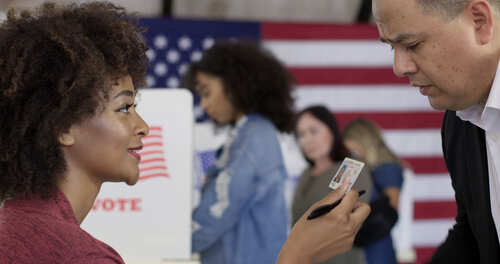
California guidance says most voters are not required to show identification at a polling place. There is a narrow exception for certain first-time voters who registered by mail and did not provide the listed numbers. Those voters may be asked for proof the first time they vote in a federal election. That is a small slice of the electorate. For nearly everyone else, poll workers do not routinely ask for identification before handing out a ballot.
For those limited first-time voters who are flagged, the acceptable identification list includes more than photo documents. A voter may show a recent utility bill, a sample ballot booklet sent by the county, or another government document. A passport, driver license, state identification, or student identification also qualifies. These options meet the federal standard, but they are a far cry from a strict show-photo-ID rule that many states use. The mix reflects California’s permissive approach to access.
What Supporters and Critics Say About Safeguards
State officials argue identity checks happen at many points. They cite database matches for driver’s license and Social Security numbers. They also point to routine updates for death and felony status. A Senate testimony summary quotes the Secretary of State saying in-person impersonation is rare and fraud cases are very low. That position leans on system checks and low incident counts as proof the rules are working as designed.
Critics counter that the biggest gap is at the start. They say registration should require firm proof before a record is created. California’s approach allows people to leave key fields blank and still be processed. The state then backfills identity through data matching and a unique identifier. That puts the burden on government systems and poll workers later, not on the applicant at the beginning. The rules make abuse harder to detect upfront, even if later checks can catch some issues.
Why This Matters Now For Trust And Turnout
Election trust depends on both strong rules and public confidence. California’s model favors access and administrative matching. Many conservatives prefer a simple rule at the door: show government identification, get a ballot. The current framework means most voters never show identification at the polls. That invites doubt, even if officials cite low fraud counts. Tighter rules could improve confidence without blocking lawful voters, if smartly designed and clearly implemented.
Practical steps can close gaps without chaos. Lawmakers and county officials can release counts on how many registrants receive unique identifiers. They can publish how many first-time voters were asked for identification and what documents cured the flag. They can report match failure rates with Department of Motor Vehicles and Social Security records. Clear, routine reporting would let the public see if the safety net is working. Sunlight strengthens honest votes and deters bad actors.
Sources:
thegatewaypundit.com, sos.ca.gov, elections.cdn.sos.ca.gov, voteriders.org, ballotpedia.org