

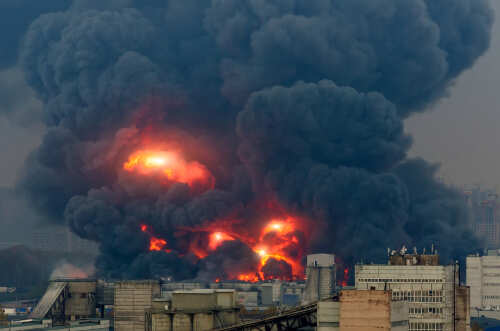
Ukraine’s latest drone barrage struck a Moscow oil refinery near the Kremlin, exposing Russia’s soft underbelly and choking the capital in smoke.
Story Snapshot
- Ukraine hit Moscow’s Kapotnya refinery in one of the war’s biggest strikes on the capital [4].
- Fires, smoke, and damage were documented; flights were briefly halted at Moscow airports [1][3].
- Russian officials claimed massive interceptions, but some drones still got through to key infrastructure [4].
- Kyiv says the goal is to make Russians feel the war at home after years of strikes on Ukraine [3].
Direct Hit On Fuel Infrastructure Inside Moscow
Reporters said Ukrainian drones reached the Kapotnya oil refinery, roughly ten miles from the Kremlin. The strike produced fire and thick black smoke over the city. Video from the scene showed an explosion at a storage tank area. The plant had already been targeted earlier in the week, suggesting a pattern rather than a one-off. These details point to real damage at a key fuel site, not just drones shot down at the edge of the city [1][3][4].
Moscow’s mayor and federal officials announced large interception totals and said air defenses stopped most incoming drones. Even so, coverage confirmed the refinery was hit and fires broke out. That means at least some drones penetrated the defensive rings around the capital. The refinery’s location inside the Moscow region and the visible smoke over the city underline the reach of Ukraine’s long-range systems and the limits of Russia’s shield [3][4].
Wider Disruption: Airports, Housing, And Injuries
Air traffic in Moscow was disrupted as airports paused operations during the attack windows. Local officials reported damage to a residential high-rise, private houses, and an industrial site in the region. Injury counts varied across outlets, which is common during fast-moving events, but several reports put the figure above a dozen. The picture that emerges is clear: normal life in Moscow was shaken, even if Russian agencies emphasize interceptions and control [1][3][4].
Oil infrastructure is central to Russia’s economy and its war machine. Coverage tied recent refinery hits to fuel strain across parts of Russia, with knock-on effects including imports by sea to cover shortages after earlier strikes. While the exact lasting damage at Kapotnya is not yet quantified, the campaign’s pressure on refineries has shown real economic consequences beyond dramatic footage. These are not only symbolic raids; they have supply implications inside Russia [1][4].
Kyiv’s Stated Aim And The Meaning For U.S. Interests
Ukrainian leaders have said deep strikes are meant to make Russians “feel the consequences of war at home” and to answer Russia’s repeated attacks on Ukrainian cities. Major outlets described this Moscow operation as among the largest against the capital since the full-scale war began. Kyiv’s message is simple: distance and air defenses will not grant Moscow immunity while Russian drones and missiles batter Ukrainian civilians and power grids [3][4].
#Ukraine appears to be taking the fight deep into #Russian territory…A massive drone attack forced the temporary shutdown of all four #Moscow airports. @kartikeya_1975 @SwaranSinghJNU #OnPoint
https://t.co/AlOdU9Hzkf— News9 (@News9Tweets) June 22, 2026
For American readers, two truths stand out. First, hard power works: determined defenders can innovate with low-cost drones and hit targets once thought untouchable. Second, propaganda fog is thick: officials in Moscow highlight interceptions, while open-source videos show flames at a refinery. The facts we can verify are limited but important. The refinery burned, airports paused, civilians were affected, and the capital’s confidence took a hit. That is a strategic signal, not just a headline [1][3][4].
What We Know, What We Do Not
We know the strike reached a critical energy site inside Moscow’s ring roads, triggered fires, and disrupted flights. We know officials reported injuries and damaged housing. We also know reporting varies on casualty totals and on the depth of structural harm at the refinery. We do not yet have a full, independent damage audit, outage length, or precise production loss. Until those records surface, claims about long-term impact should be treated as provisional and grounded in confirmed observations [1][3][4].
Why This Matters To Conservatives
This episode shows that borders and big bureaucracies do not guarantee safety when technology and willpower align. It also shows how energy security is national security. When fuel infrastructure is vulnerable, families, markets, and militaries all feel it. Americans should demand clear-eyed policy that strengthens our own refineries, grids, and defenses at home. We should resist globalist distractions, secure supply chains, and keep government focused on core duties: protect our people, our economy, and our freedom.
Sources:
[1] Web – Target Moscow: The Ukraine War Has Come Right to Putin’s Doorstep
[3] Web – Ukrainian forces struck the Moscow Oil Refinery in the Russian …
[4] Web – Ukraine launches largest attack on Moscow since start of full-scale …