
American naval forces successfully defended three U.S. Navy destroyers against an Iranian barrage of missiles, drones, and fast-attack boats in the Strait of Hormuz, striking back at Iranian military facilities and raising questions about the fragile month-old ceasefire between the two nations.
Story Snapshot
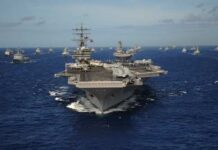
- Three U.S. Navy destroyers (USS Truxton, USS Mason, USS Rafael Peralta) repelled unprovoked Iranian attacks using missiles, drones, and swarms of small boats in the Strait of Hormuz on May 7.
- No American vessels were struck during the Iranian assault, and U.S. forces responded with self-defense strikes on Iranian military facilities, including missile and drone launch sites.
- President Trump confirmed the destroyers exited the strait “under fire” and will rejoin a defensive blockade, describing Iranian forces as “completely destroyed.”
- The incident marks the most direct known exchange between U.S. and Iranian forces since a ceasefire began roughly one month ago, threatening ongoing peace negotiations.
Iranian Attack Forces U.S. Response
Three U.S. Navy guided-missile destroyers came under coordinated attack while transiting the Strait of Hormuz on May 7, according to U.S. Central Command (CENTCOM). Iranian forces launched multiple missiles, drones, and fast-attack boats at USS Truxton (DDG-103), USS Rafael Peralta (DDG-115), and USS Mason (DDG-87) as the warships moved through the strategic international waterway toward the Gulf of Oman [1]. The assault represented an escalation in gray-zone tactics that Iran has employed for years in this chokepoint, testing American naval defenses without crossing into outright war [1].
U.S. forces intercepted the incoming threats and responded with self-defense strikes against Iranian military targets responsible for the attack. CENTCOM confirmed that American forces eliminated inbound threats and targeted Iranian facilities including missile and drone launch sites, command-and-control locations, and intelligence and surveillance nodes positioned near the strait [1][2]. Despite the intensity of the Iranian barrage—with swarms of fast-attack boats maneuvering close enough that American warships opened fire to keep them at bay—no U.S. vessels sustained damage [1].
Trump Confirms Destroyers Successfully Exit Under Fire
President Trump described the confrontation in aggressive terms, confirming that the three destroyers exited the strait under fire and will rejoin a defensive blockade. Trump stated that American forces dealt “great damage” to Iranian attackers, claiming Iranian small boats “went to the bottom of the Sea, quickly and efficiently” [1]. He warned Tehran that the United States would respond “a lot harder, and a lot more violently” if Iran does not quickly agree to a broader nuclear deal, framing the clash as pressure on Tehran to negotiate [1].
Ceasefire Fractures Amid Competing Narratives
The incident threatens a monthlong ceasefire negotiated between the two countries to buy time for longer-term peace talks. Defense Secretary Pete Hegseth confirmed the ceasefire remains technically in place, while Secretary of State Marco Rubio stated that Operation Epic Fury—the initial U.S. military campaign against Iran—is over [1]. However, Iran’s military command has accused the United States of violating the ceasefire, claiming American forces attacked an Iranian oil tanker first, prompting Iran’s response [5]. Iranian state media denies that U.S. strikes destroyed Iranian boats or facilities, creating a stark divergence in official narratives [6].
🚨 BREAKING: US Navy destroyer intercepted an Iranian attack in the Strait of Hormuz on May 7. US forces returned fire in self-defense. No casualties reported. Tensions escalate in key oil chokepoint.
— Flash Feed Macro (@FlashFeedMacro) May 7, 2026
CENTCOM emphasized that it “does not seek escalation” and remains positioned to protect American forces and maintain freedom of navigation through the strait [2]. The U.S. military’s measured posture contrasts with Trump’s more confrontational rhetoric, revealing internal tension over how aggressively to respond to Iranian provocations while preserving diplomatic channels. The exchange highlights the precarious balance the Trump administration must maintain: demonstrating resolve to deter Iranian aggression while avoiding actions that collapse ceasefire negotiations and trigger broader conflict [1].
Sources:
[1] U.S. strikes 2 Iranian ports as American warships come under fire
[2] Iran and U.S. exchange fire in Strait of Hormuz
[5]
[6] 2 U.S. Navy destroyers transit Strait of Hormuz after dodging Iranian …