
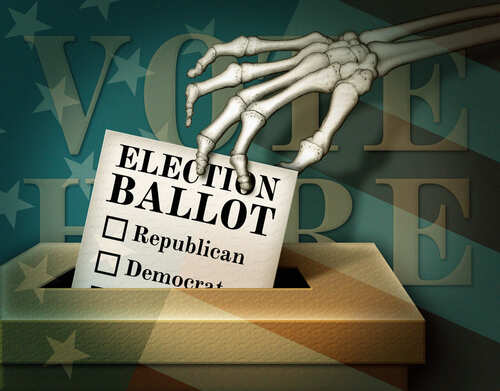
Assistant Attorney General Harmeet Dhillon reveals at least 350,000 dead people linger on voter rolls in just 16 states, exposing a ticking time bomb for election integrity that demands immediate federal action.
Story Highlights
- DOJ identifies hundreds of thousands of dead voters and tens of thousands of noncitizens on rolls from 16 cooperating Republican states like Florida and Texas.
- Trump’s DOJ sues 29 states plus DC for refusing access to full voter rolls, enforcing long-ignored federal cleanup laws.
- Findings from voluntary audits justify aggressive litigation to prevent fraud ahead of midterms.
- Bipartisan suits target red and blue states alike, countering claims of political targeting.
- Critics downplay impact, but unremoved ineligible names undermine trust in every ballot cast.
DOJ Launches Nationwide Voter Roll Cleanup
Harmeet K. Dhillon, Assistant Attorney General for Civil Rights, disclosed preliminary audit results from 16 Republican-leaning states including Florida and Texas. These voluntary disclosures uncovered at least 350,000 dead individuals still listed on voter rolls, alongside tens of thousands of noncitizens and duplicate registrations. Federal laws like the National Voter Registration Act of 1993 and Help America Vote Act of 2002 require states to maintain clean lists by removing the deceased, movers, and duplicates. Dhillon emphasized these issues persist despite clear mandates, fueling concerns over potential election vulnerabilities.
Legal Action Against Noncompliant States
The Department of Justice under Attorney General Pamela Bondi initiated lawsuits against 29 states and Washington, DC, for failing to provide unredacted voter rolls. Actions began in early 2026 with requests under the Civil Rights Act of 1960, which empowers the Attorney General to demand records for compliance. On February 26, 2026, DOJ sued Utah, Oklahoma, Kentucky, West Virginia, and New Jersey. Recent suits added Delaware, Maryland, New Mexico, Rhode Island, Vermont, and Washington. Bondi described the effort as proactive election integrity litigation to safeguard American votes.
Noncompliant states resist on grounds of privacy and federal overreach, opting to fight in court rather than cooperate. Blue states like California and New York face particular scrutiny, as their defiance blocks comprehensive audits. Red states like Utah and Oklahoma also balk, highlighting bipartisan resistance. Dhillon noted states prefer litigation over simply showing their maintenance work, delaying nationwide cleanup efforts critical for fair elections.
Trump Administration’s Commitment to Secure Elections
This campaign stems from post-2020 and 2024 election fraud concerns, prompting President Trump’s DOJ to conduct systematic audits. Voluntary compliance from 16 mostly GOP states revealed shocking irregularities, justifying suits against holdouts. Dhillon, a veteran election litigator, leads public communications, appearing on Fox News and other outlets to reiterate findings. The approach uses federal supremacy to neutralize partisan accusations, as suits span both red and blue jurisdictions.
Short-term court battles may delay full audits but pave the way for roll cleanups before 2026 midterms. Long-term, this sets precedent for ongoing federal oversight and potential new laws mandating better maintenance technology. Litigation costs burden states and election officials, while communities risk erroneous purges. Politically, it bolsters conservative pushes for integrity, pressuring resistant Democrat-led states to prioritize secure voting over excuses.
Harmeet Dhillon on DOJ Suing Multiple States and DC Over Access to Voter Rolls: 'We Have Found at Least 350,000 Dead People Currently On the Voter Rolls' (VIDEO) https://t.co/8wzaMtzgY8 #gatewaypundit via @gatewaypundit
— Michael Carey (@michael_ca87794) April 20, 2026
Conservative Victory Amid Partisan Divide
Conservatives hail the DOJ’s actions as vindication of long-standing fraud prevention demands, aligning with President Trump’s America First agenda for transparent elections. Progressive outlets like Democracy Docket claim only dozens of actual illegitimate votes surfaced, distinguishing registrations from cast ballots. However, unremoved dead and noncitizen names erode public trust, regardless of voting incidence. Historical precedents like Judicial Watch suits removed millions of inactives, proving proactive maintenance works. Full results await litigation outcomes, but preliminary data from half the states underscores urgency.